
 Call a Friend
 Create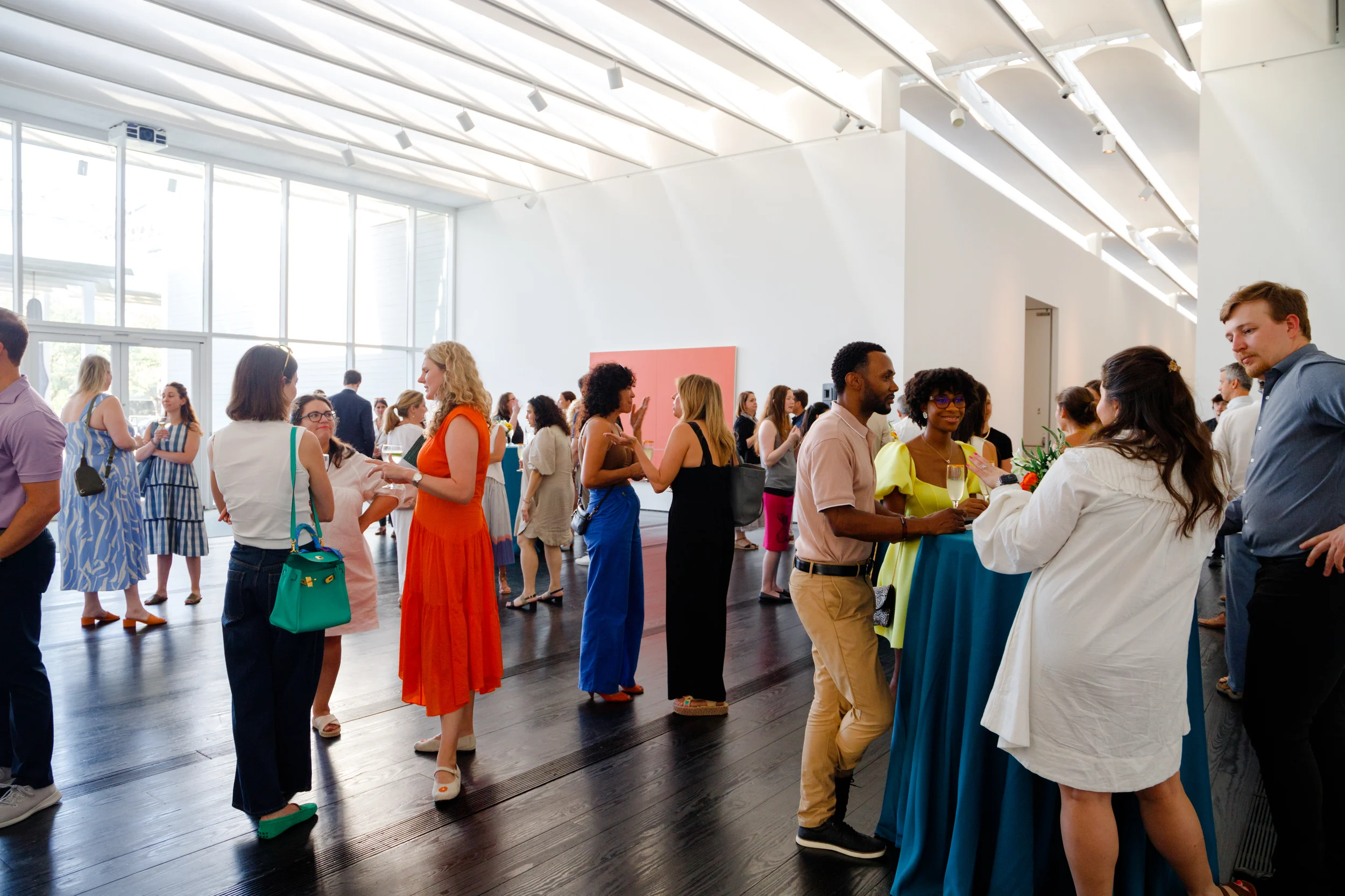
Inside Dominique de Menil’s quiet vision of beauty, freedom and human connection
By Lydia™ @Lydia.com
Houston Living · Approximately 5 minutes
In a quiet Montrose neighborhood, grey-painted bungalows, old oak trees and stretches of open lawn gradually give way to a museum that barely announces itself. The Menil Collection does not rise above its surroundings like a monument. It settles among them.
That modesty is intentional. Dominique de Menil wanted a place where art could be experienced without intimidation—close to the body, softened by natural light and free from the feeling that a visitor must already know what to think.
A Museum That Refuses to Shout
The Menil’s main building opened in 1987. Its architect, Renzo Piano, had helped design Paris’s boldly exposed Centre Pompidou, yet his first American commission took a very different direction. Dominique asked for a museum that would be “small on the outside and big on the inside.”
Piano and engineer Peter Rice answered with an understated structure clad in grey wood, echoing the neighborhood houses around it. Above the galleries, curved concrete leaves filter Houston’s intense sunlight, allowing a gentle, changing brightness to enter without placing the art in direct glare.
The result feels neither grand nor austere. Interior gardens interrupt the galleries; windows return the eye to weather and trees. Architecture does not compete with the collection. It creates the conditions for attention.
Dominique’s Unconventional Eye
Dominique Schlumberger de Menil was born in Paris in 1908. She studied mathematics and physics before marrying John de Menil in 1931. The family left France during the Second World War and settled in Houston, where the couple became influential patrons, collectors and educators.
Their serious engagement with modern art was encouraged by the Dominican priest Marie-Alain Couturier, who believed contemporary artists could renew sacred experience. The de Menils collected across periods and cultures, but their choices were connected less by chronology than by questions of mystery, suffering, faith and human imagination.
After John’s death in 1973, Dominique carried their shared vision forward. Rather than divide the collection among established museums, she created a place that preserved its intimacy.
Today, the Menil holds more than 25,000 works, ranging from antiquity to contemporary art, with particular strengths in Surrealism, modern and contemporary art, icons, works from Africa and the Pacific, and drawings.
Freedom to Look Slowly
The museum’s distinctive philosophy becomes visible in the galleries. Works are given space. Labels do not dominate. Paintings are often hung at a comfortable height, encouraging a direct encounter rather than the feeling of looking upward at something placed beyond ordinary life.
Only a small portion of the collection can be displayed at once, so returning visitors may find unfamiliar combinations and new conversations between objects. A Byzantine icon may lead toward Surrealism; an ancient form may quietly echo a modern sculpture.
This approach asks something gentle but demanding of the visitor: attention.
There is no requirement to admire everything or to understand immediately. Looking becomes less like completing a cultural assignment and more like listening to another person without preparing a reply.
“The Menil’s quiet luxury is not wealth on display. It is the freedom to stand before something unfamiliar and take one’s time.”
Art, Faith and Human Rights
For Dominique de Menil, art was never isolated from moral life. She and John supported civil-rights initiatives and exhibitions by Black artists.
The Menil Foundation sponsored the landmark 1971 De Luxe Show in Houston’s Fifth Ward, bringing Black and white artists together in a neighborhood venue rather than a traditional museum.
Their interests also shaped the nearby Rothko Chapel, opened in 1971 as a nonsectarian place for art, contemplation and human rights. In 1986, Dominique and former president Jimmy Carter established the Carter-Menil Human Rights Foundation.
These projects do not make every collecting decision simple or beyond question. A private collection inevitably reflects its makers’ wealth, access and perspective.
What distinguishes the Menil is the effort to turn privilege outward—toward education, public access and encounters across cultures.
A Neighborhood Made for Wandering
The Menil is now more than one museum building. Its thirty-acre campus includes the Cy Twombly Gallery, the Menil Drawing Institute, the Dan Flavin Installation at Richmond Hall and generous green spaces woven into the surrounding neighborhood.
Admission to the museum remains free. That fact changes the emotional character of a visit. One can enter for an afternoon, return to a single painting, sit beneath an oak tree or leave after twenty minutes without needing to justify the price of admission.
Houston is a city accustomed to bigness. The Menil offers another kind of confidence: low buildings, quiet rooms, filtered light and art allowed to speak without being hurried.
Dominique de Menil’s legacy is not simply the collection she helped assemble. It is a way of welcoming people into its presence.
The museum trusts that curiosity does not need to be forced—and that when beauty is given room to breathe, visitors may begin to breathe differently too.
Research & Sources
The Menil Collection. “About the Menil Collection.”
https://www.menil.org/about
The Menil Collection. “Discover the Collection.”
https://www.menil.org/collection
The Menil Collection. “Campus.”
https://www.menil.org/campus
The Menil Collection. “Plan Your Visit.”
https://www.menil.org/visit
Texas State Historical Association. “Dominique de Menil.”
https://www.tshaonline.org/handbook/entries/menil-dominique-isaline-schlumberger-de
Texas State Historical Association. “Menil Collection.”
https://www.tshaonline.org/handbook/entries/menil-collection
Texas State Historical Association. “The De Luxe Show.”
https://www.tshaonline.org/handbook/entries/de-luxe-show
Houston History Magazine. “Art without Artifice: The Menil Collection.”
https://houstonhistorymagazine.org/2014/03/art-without-artifice-the-menil-collection/
Lydia™ provides independent editorial commentary informed by the sources listed above.
Lydia™ Editorial Disclaimer
This independent editorial article is provided for general cultural and educational purposes. Lydia.com is not affiliated with or endorsed by the Menil Collection.
Opening hours, exhibitions, events, access arrangements and photography policies may change. Please consult the official Menil website before visiting. Artwork and image rights should be confirmed separately.