
 Call a Friend
 Create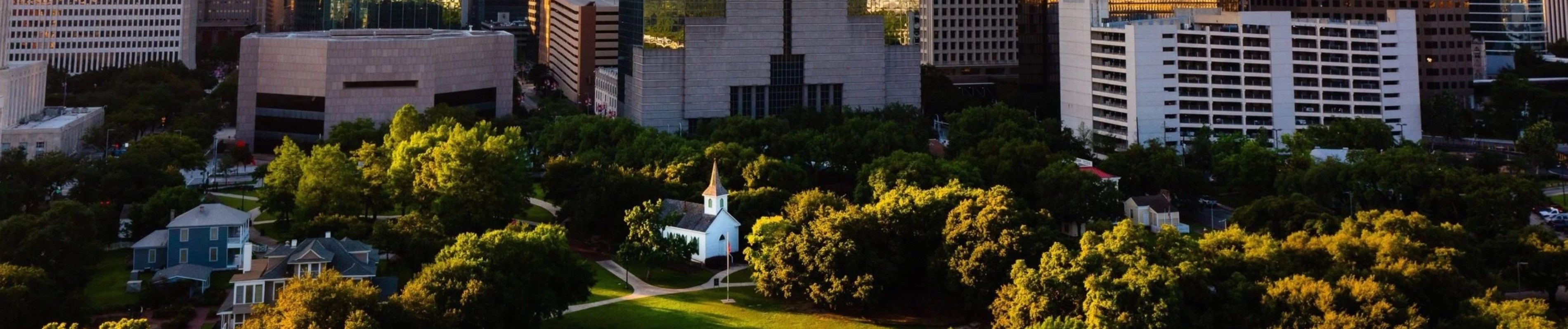
Inside a downtown park where preservation has become a conversation about memory, belonging and whose stories survive
By Lydia™ @Lydia.com
Houston Living · Approximately 5 minutes
At the edge of downtown Houston, small wooden houses and an old brick residence sit beneath towers of steel and glass. The contrast is almost theatrical: a city famous for replacing itself has placed fragments of its earlier life where the modern skyline cannot ignore them.
The Heritage Society at Sam Houston Park preserves ten buildings dating from 1823 to 1905. Yet its most important subject is not architecture alone. It is the changing question behind every act of preservation: What should a city remember—and whose lives must be included in the answer?
A House Marked for Demolition
Sam Houston Park began in 1899, when the City of Houston acquired land for its first municipal park. Its paths, stream and Victorian landscaping offered relief from a growing downtown. The grounds even briefly contained Houston’s first zoo.
Already standing there was the 1847 Kellum-Noble House. Built by Nathaniel Kellum with bricks made from Buffalo Bayou clay and labor performed by enslaved people, it later became the Noble family home. Zerviah Noble and her daughter Catherine operated one of the area’s earliest schools inside its rooms.
By 1954, the house had deteriorated and the city planned to demolish it. Houston’s appetite for growth was consuming older buildings with little ceremony. Kellum-Noble might have disappeared as quietly as many others.
The Women Who Organized Memory
Instead, concerned Houstonians organized to save it. The City of Houston identifies Faith Bybee, Marie Phelps and architect Harvin Moore as founders of the organization now known as The Heritage Society. A fuller account in Houston History Magazine describes a wider circle of women and men, including Ima Hogg, who raised money and expertise for the restoration.
Their achievement was practical before it was philosophical: stop the demolition, stabilize the building and give it a public purpose. But rescuing one house established a larger principle. A city’s confidence need not depend upon erasing evidence of what came before.
Preservation begins by saving a structure; it matures by asking whether the whole human story has been allowed inside.
A Park of Many Houstons
Other buildings gradually joined Kellum-Noble, most relocated from threatened sites. Together they form less a perfect old village than a collection of surviving witnesses.
The 1866 Fourth Ward Cottage once stood in what became Freedmen’s Town. Modified repeatedly and occupied as a rental house for more than a century, its exposed materials reveal how residents adapted limited space and resources.
The 1870 Yates House belonged to the Reverend Jack Yates, who emerged from slavery to become a minister, educator and civic leader. His two-story home represented family achievement and the power of ownership only five years after emancipation.
There are also stories of immigration, religion, domestic labor, childhood and women’s education. The buildings do not describe one Houston. They show how many Houstons occupied the same expanding city, often with profoundly unequal freedom and security.
When Preservation Learns to Tell More
Historic-house museums once tended to emphasize architecture, furnishings and prominent owners. Those details remain valuable, but polished rooms can make the past appear gentler than it was. Kellum-Noble cannot be interpreted honestly without the enslaved people whose labor helped build it.
The Heritage Society now offers Black History and Women’s History tours alongside its general building tours. In 2022, the Kellum-Noble House, Fourth Ward Cottage and Yates House were recognized within UNESCO’s project concerning the routes and experiences of enslaved peoples.
This broader interpretation does not diminish the founders’ preservation work. It fulfills it. Saving the physical evidence allows later generations to ask better questions than earlier generations knew—or wished—to ask.
The Skyline and the Small Houses
There is an unavoidable compromise in Sam Houston Park. Except for Kellum-Noble, the historic buildings have been moved from the streets and neighborhoods that originally gave them context. Relocation protected them from destruction, but a preserved house can never carry its entire landscape with it.
Still, the gathering has value. Beneath the skyscrapers, differences of scale become differences of time. A narrow cottage, church or family house reminds visitors that cities are not made only by grand plans and commercial ambition. They are made in classrooms, kitchens, rented rooms, congregations and the patient work of establishing a home.
Houston will continue to rebuild itself; reinvention is part of its character. The Heritage Society does not ask the city to stop changing. It asks change to remain in conversation with memory—and reminds us that saving the past is only the beginning. The deeper responsibility is to keep learning how to tell it whole.
Research & Sources
The Heritage Society — Main Site and Historic Buildings
heritagesociety.org
The Heritage Society — Kellum-Noble House
heritagesociety.org
The Heritage Society — Fourth Ward Cottage
heritagesociety.org
The Heritage Society — Sam Houston Park
heritagesociety.org
Houston History Magazine — “More than a Museum: Living History and a Vibrant Future at The Heritage Society in Sam Houston Park”
houstonhistorymagazine.org
City of Houston — The Heritage Society
houstontx.gov
Houston Chronicle — “Historic Home Tour Traces Black Houstonians’ Journey from Slavery to Homeownership,” June 19, 2025
houstonchronicle.com
Lydia™ provides independent editorial commentary informed by the sources listed above.
Lydia™ Editorial Disclaimer
This article provides general cultural and educational commentary. Historical interpretation may evolve as archives, scholarship and community knowledge develop. Buildings, exhibitions, tour offerings, admission, accessibility and opening hours may change. Consult The Heritage Society’s official website for current visitor information and policies.
Inside a downtown park where preservation has become a conversation about memory, belonging and whose stories survive
By Lydia™ @Lydia.com
Houston Living · Approximately 5 minutes
At the edge of downtown Houston, small wooden houses and an old brick residence sit beneath towers of steel and glass. The contrast is almost theatrical: a city famous for replacing itself has placed fragments of its earlier life where the modern skyline cannot ignore them.
The Heritage Society at Sam Houston Park preserves ten buildings dating from 1823 to 1905. Yet its most important subject is not architecture alone. It is the changing question behind every act of preservation: What should a city remember—and whose lives must be included in the answer?
A House Marked for Demolition
Sam Houston Park began in 1899, when the City of Houston acquired land for its first municipal park. Its paths, stream and Victorian landscaping offered relief from a growing downtown. The grounds even briefly contained Houston’s first zoo.
Already standing there was the 1847 Kellum-Noble House. Built by Nathaniel Kellum with bricks made from Buffalo Bayou clay and labor performed by enslaved people, it later became the Noble family home. Zerviah Noble and her daughter Catherine operated one of the area’s earliest schools inside its rooms.
By 1954, the house had deteriorated and the city planned to demolish it. Houston’s appetite for growth was consuming older buildings with little ceremony. Kellum-Noble might have disappeared as quietly as many others.
The Women Who Organized Memory
Instead, concerned Houstonians organized to save it. The City of Houston identifies Faith Bybee, Marie Phelps and architect Harvin Moore as founders of the organization now known as The Heritage Society. A fuller account in Houston History Magazine describes a wider circle of women and men, including Ima Hogg, who raised money and expertise for the restoration.
Their achievement was practical before it was philosophical: stop the demolition, stabilize the building and give it a public purpose. But rescuing one house established a larger principle. A city’s confidence need not depend upon erasing evidence of what came before.
Preservation begins by saving a structure; it matures by asking whether the whole human story has been allowed inside.
A Park of Many Houstons
Other buildings gradually joined Kellum-Noble, most relocated from threatened sites. Together they form less a perfect old village than a collection of surviving witnesses.
The 1866 Fourth Ward Cottage once stood in what became Freedmen’s Town. Modified repeatedly and occupied as a rental house for more than a century, its exposed materials reveal how residents adapted limited space and resources.
The 1870 Yates House belonged to the Reverend Jack Yates, who emerged from slavery to become a minister, educator and civic leader. His two-story home represented family achievement and the power of ownership only five years after emancipation.
There are also stories of immigration, religion, domestic labor, childhood and women’s education. The buildings do not describe one Houston. They show how many Houstons occupied the same expanding city, often with profoundly unequal freedom and security.
When Preservation Learns to Tell More
Historic-house museums once tended to emphasize architecture, furnishings and prominent owners. Those details remain valuable, but polished rooms can make the past appear gentler than it was. Kellum-Noble cannot be interpreted honestly without the enslaved people whose labor helped build it.
The Heritage Society now offers Black History and Women’s History tours alongside its general building tours. In 2022, the Kellum-Noble House, Fourth Ward Cottage and Yates House were recognized within UNESCO’s project concerning the routes and experiences of enslaved peoples.
This broader interpretation does not diminish the founders’ preservation work. It fulfills it. Saving the physical evidence allows later generations to ask better questions than earlier generations knew—or wished—to ask.
The Skyline and the Small Houses
There is an unavoidable compromise in Sam Houston Park. Except for Kellum-Noble, the historic buildings have been moved from the streets and neighborhoods that originally gave them context. Relocation protected them from destruction, but a preserved house can never carry its entire landscape with it.
Still, the gathering has value. Beneath the skyscrapers, differences of scale become differences of time. A narrow cottage, church or family house reminds visitors that cities are not made only by grand plans and commercial ambition. They are made in classrooms, kitchens, rented rooms, congregations and the patient work of establishing a home.
Houston will continue to rebuild itself; reinvention is part of its character. The Heritage Society does not ask the city to stop changing. It asks change to remain in conversation with memory—and reminds us that saving the past is only the beginning. The deeper responsibility is to keep learning how to tell it whole.
Research & Sources
The Heritage Society — Main Site and Historic Buildings
heritagesociety.org
The Heritage Society — Kellum-Noble House
heritagesociety.org
The Heritage Society — Fourth Ward Cottage
heritagesociety.org
The Heritage Society — Sam Houston Park
heritagesociety.org
Houston History Magazine — “More than a Museum: Living History and a Vibrant Future at The Heritage Society in Sam Houston Park”
houstonhistorymagazine.org
City of Houston — The Heritage Society
houstontx.gov
Houston Chronicle — “Historic Home Tour Traces Black Houstonians’ Journey from Slavery to Homeownership,” June 19, 2025
houstonchronicle.com
Lydia™ provides independent editorial commentary informed by the sources listed above.
Lydia™ Editorial Disclaimer
This article provides general cultural and educational commentary. Historical interpretation may evolve as archives, scholarship and community knowledge develop. Buildings, exhibitions, tour offerings, admission, accessibility and opening hours may change. Consult The Heritage Society’s official website for current visitor information and policies.