
 Call a Friend
 Create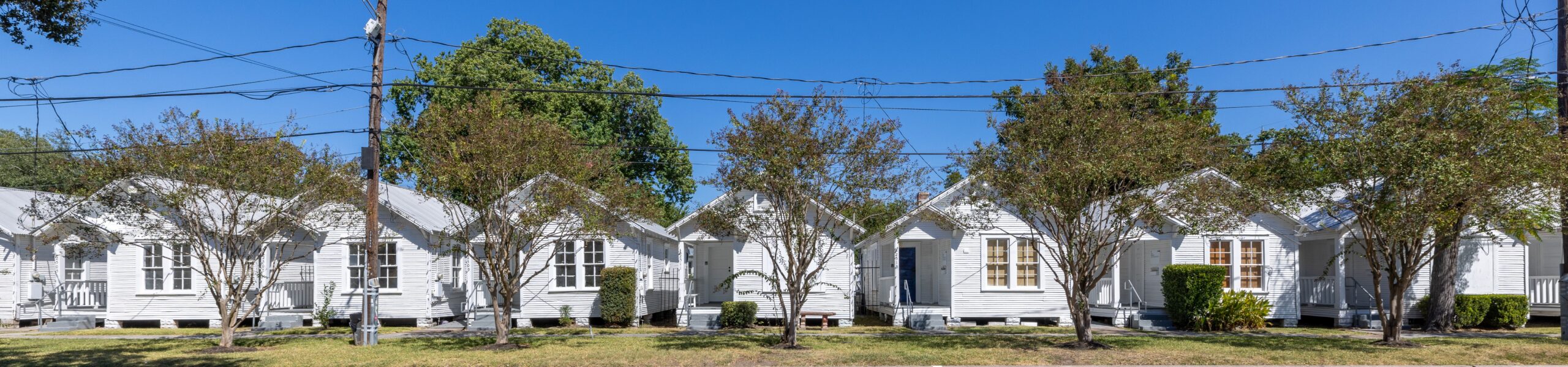
Project Row Houses: When a Neighborhood Became the Work of Art
How 22 shotgun houses became a living practice of art, care and placekeeping
By Lydia™ @Lydia.com
Houston Living · Approximately 5 minutes
On Holman Street in Houston’s Third Ward, a row of modest wooden houses asks a radical question: What if art were not merely placed inside a community, but created through the work of sustaining one?
Project Row Houses began with 22 neglected shotgun houses and seven Black artists who refused to see them as disposable.
More than three decades later, the project occupies five city blocks, yet its most important material remains the same—people imagining what they can build together.
Seeing Possibility in the Row
In 1993, James Bettison, Bert Long Jr., Jesse Lott, Rick Lowe, Floyd Newsum, Bert Samples and George Smith recognized possibility in a block and a half of deteriorating houses at Holman and Live Oak.
Hundreds of volunteers helped clear debris, repair porches and prepare the buildings for a new life.
Their vision was shaped by Houston artist and educator John Biggers, whose paintings treated shotgun houses as expressions of African American ingenuity and community.
The narrow form—with doors aligned to capture a breeze—traveled from West Africa through the Caribbean and became common across the Gulf Coast and in Black neighborhoods built after Emancipation.
The founders were also influenced by artist Joseph Beuys and his idea of “social sculpture”: the belief that people working together to shape society can itself be an artistic act.
At Project Row Houses, the buildings would not simply contain art. Their restoration, use and relationships would become the work.
Art With the Front Door Open
The first artist installations opened in 1994. Rather than entering a white-walled gallery separated from ordinary life, visitors moved from porch to porch and room to room.
Artists responded to the architecture, the history of Third Ward and conversations with residents.
That approach continues through rotating art-house installations, residencies, community exhibitions, studios and public programs. The houses make art intimate without making it small. A single room can hold memory, protest, humor, grief or an imagined future.
Project Row Houses calls this socially engaged art: people talking, working and creating together.
The definition shifts attention away from the artist as solitary genius. Meaning is produced through relationships—and those relationships require listening, accountability and time.
Care Is Part of the Artwork
From its early years, Project Row Houses connected cultural work with practical support.
Its historic Young Mothers Residential Program offered housing and stability to single mothers working toward education and greater independence. Later initiatives have included youth arts education, mentoring, food distribution, creative-business support and affordable artist space.
These activities are not an extra charitable layer added to the art. They express the original idea that creativity should help a community develop the capacity to act on its own priorities.
Women have been central to this social sculpture—as residents, mothers, artists, organizers, entrepreneurs, staff members and neighbors.
Their experience complicates any easy division between cultural life and everyday survival. A home can be architecture, memory, economic security and the place from which a woman begins again.
“At Project Row Houses, art is not what remains after practical needs are met. It is one way people imagine how those needs might be met together.”
From Preservation to Placekeeping
Project Row Houses has expanded from the original houses into a network of cultural and neighborhood initiatives.
Its work has included affordable housing developed with the Rice Building Workshop and stewardship of the historic Eldorado Ballroom, once a celebrated center of Black music and social life.
The organization describes its purpose as placekeeping rather than preserving a culture behind glass.
Third Ward is not an abandoned past. It is a living neighborhood facing rising land values, redevelopment and a decline in the number of Black families able to remain.
Art-led development cannot escape those pressures. Decisions about property, tenancy, investment and access carry real consequences.
Project Row Houses’ significance lies partly in its willingness to keep these questions visible: Who benefits when a neighborhood changes? Whose history creates its value? Who gets to stay and participate in its future?
A Work That Must Stay Alive
A conventional artwork can be completed, framed and protected. A social sculpture cannot.
Houses age. Programs evolve. Funding changes. Neighbors disagree. New generations inherit questions the founders could not answer in advance.
That unfinished quality is not failure. It is evidence that Project Row Houses remains connected to life rather than becoming a monument to its own reputation.
Visitors may come to see installations, architecture or an internationally known arts organization. What they encounter is a more demanding idea: creativity carries obligations to place and people.
The shotgun houses survived because artists recognized that they already contained knowledge. Their porches, proportions and repeated rhythm held the memory of movement across continents and generations.
Project Row Houses did not make Third Ward culturally valuable. It made a public commitment to value what was already there—and to keep asking what that commitment requires.
Research & Sources
Project Row Houses. “History.”
https://projectrowhouses.org/about/history/
Project Row Houses. “Programs and Projects.”
https://projectrowhouses.org/our-work/programs/
Project Row Houses. “Visit Project Row Houses.”
https://projectrowhouses.org/visit-us/
U.S. Department of Housing and Urban Development. “Project Row Houses Uses Art to Preserve History and Create Affordable Housing.”
https://www.huduser.gov/portal/casestudies/study-062421.html
Museum of Fine Arts, Houston. “Art, Place, and Power: Project Row Houses in Houston’s Third Ward.”
https://www.mfah.org/art/exhibitions/art-place-and-power-project-row-houses-in-houstons-third-ward
Rice School of Architecture. “Project Row Houses Archive.”
https://arch.rice.edu/projects/construct/project-row-houses-archive
Society of Architectural Historians. “Project Row Houses.”
https://sah-archipedia.org/buildings/TX-01-HN97
Andy Warhol Foundation for the Visual Arts. “Project Row Houses.”
https://warholfoundation.org/grants/archive/project-row-houses/
Lydia™ provides independent editorial commentary informed by the sources listed above.
Lydia™ Editorial Disclaimer
This independent editorial article is provided for general cultural and educational purposes. Lydia.com is not affiliated with or endorsed by Project Row Houses.
Exhibitions, programs, tours, public access, business residencies and operating hours may change. Please consult the official Project Row Houses website before visiting.
Third Ward is a living residential community. Visitors should respect its residents, private property and applicable photography restrictions. Artwork and image rights should be confirmed separately.