Lydia.com exists to create a thoughtful, intelligent and emotionally grounded online environment for women.
We believe meaningful conversation is still possible on the internet when people are treated with dignity, curiosity and respect. Our goal is not to be the loudest voice in a crowded feed. Our goal is to create a place where women can share experiences, exchange ideas, learn from one another and engage in conversations that feel human.
These guidelines explain the standards that shape the content published on Lydia.com and the principles that guide our editorial decisions.
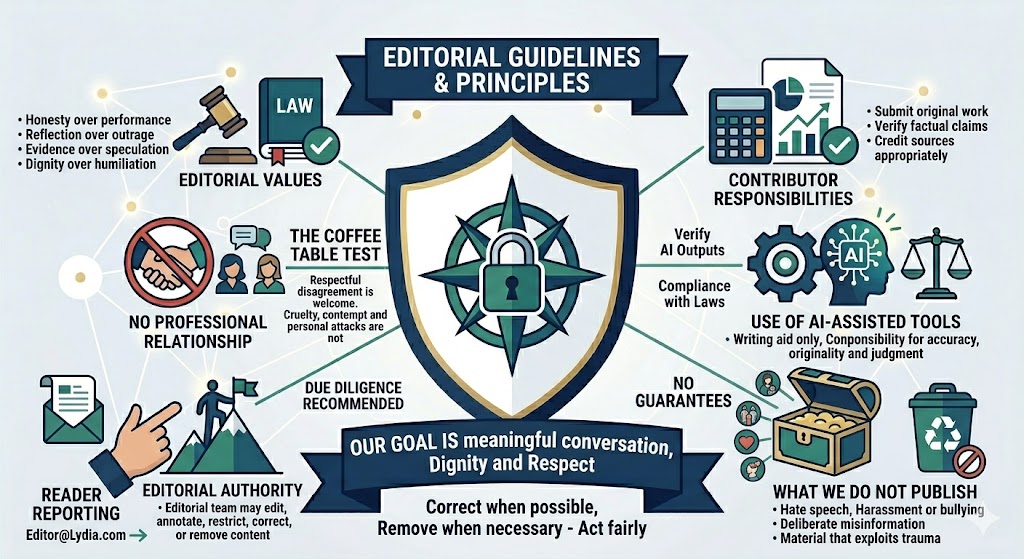
Everything published on Lydia.com should reflect the following values:
• Honesty over performance.
• Reflection over outrage.
• Understanding over hostility.
• Evidence over speculation.
• Dignity over humiliation.
• Conversation over confrontation.
We welcome different viewpoints. We do not require agreement. We do require respect.
A useful metaphor for Lydia.com is a group of women sitting together over coffee, enjoying thoughtful conversation.
Before publishing, contributors should ask:
• Would I comfortably say this face-to-face?
• Does this respect people who may disagree?
• Am I seeking understanding or simply a reaction?
• Would I stand behind these words outside the internet?
• Does this invite conversation rather than hostility?
Respectful disagreement is welcome. Cruelty, contempt and personal attacks are not.
We publish content that informs, encourages reflection and contributes meaningfully to the lives of women.
Topics may include relationships, friendship, family, health, wellbeing, career, personal growth, money, culture, aging, travel, beauty, community and lived experience.
Strong opinions may be published when they are presented thoughtfully, honestly and respectfully.
Lydia.com does not publish:
• Hate speech
• Harassment or bullying
• Personal attacks
• Deliberate misinformation
• Plagiarism
• Unverified accusations
• Invasive personal information
• Content intended primarily to provoke outrage
• Disguised advertising or deceptive promotion
• Material that exploits trauma or vulnerable individuals
Editorial decisions are guided by both the letter and spirit of these standards.
Contributors are expected to:
• Submit original work.
• Verify factual claims.
• Respect privacy.
• Credit sources appropriately.
• Disclose conflicts of interest.
• Distinguish opinion from fact.
• Accept editorial review.
The use of AI-assisted tools is permitted as a writing aid but does not replace the contributor's responsibility for accuracy, originality and judgment.
By submitting content to Lydia.com, contributors acknowledge that the editorial team may edit, annotate, restrict, correct or remove published content when necessary to maintain compliance with Lydia.com's editorial standards, legal obligations, community values, or the safety and integrity of the platform.
Where practical, contributors will be notified of significant editorial changes and given an opportunity to respond. However, Lydia.com reserves the right to take immediate action where required to address legal, ethical, safety or community concerns.
Lydia.com believes transparency builds trust.
When published content requires correction, modification, restriction or removal, we aim to act fairly, proportionately and openly.
Guiding Principle:
Correct when possible. Remove when necessary. Never materially rewrite published content without transparency.
Minor Corrections
Minor corrections may include typographical errors, broken links, formatting issues or small factual inaccuracies that do not materially change the meaning of an article.
Significant Corrections
If a correction materially affects accuracy, context, interpretation or conclusions, an Editor's Note may be added explaining that a significant correction has been made.
Policy Violations Within Otherwise Valuable Content
If an article contains material that violates Lydia.com's standards but remains valuable overall, the editorial team may remove or revise the offending section while preserving the remainder of the article.
Content Restriction
In some circumstances Lydia.com may disable comments, add context, limit distribution or temporarily unpublish content while concerns are reviewed.
Content Removal
Content may be removed when modification is insufficient. Examples include hate speech, harassment, plagiarism, serious privacy violations, unlawful content or material likely to cause significant harm.Where practical, a removal notice will remain visible so that readers understand what occurred.
Contributor Communication
Whenever practical, contributors will be informed of significant corrections, restrictions or removals and may request editorial review of those decisions.
Readers may report content they believe is inaccurate, harmful, offensive, misleading, infringing or otherwise inconsistent with Lydia.com's standards.
Please direct your concerns to : Editor@lydia.com
All reports are reviewed by the editorial team.
We respect contributors.
We respect readers.
We believe mistakes can be corrected.
We believe transparency matters.
We will act when necessary, and we will do so fairly.
A Lydia.com article should not aim to be the loudest article in a reader's feed. It should aim to be one of the few articles worth pausing to consider, remembering later and sharing with someone they respect.
Question regarding the Lydia.com Editorial Policy ?
Please send an email to : Editor@lydia.com
 Call a Friend
 Create